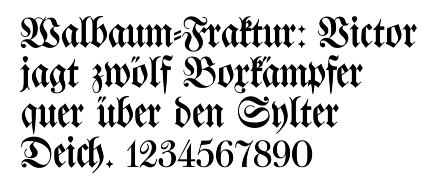
Blackletter is the dense, angular style of writing that shaped European manuscripts and early printing, and it remained closely tied to German-language typography for a long stretch of history. Several related hands sit under that single name.
What blackletter is
Blackletter describes a group of scripts marked by narrow, tall letters, strong vertical strokes, and a compressed rhythm that leaves little white space between letters — which is where the name comes from. The forms are produced naturally by a broad-edge pen held at a steep angle, giving the sharp, repeated strokes that define the style.
Three related hands
Textura
Textura is the most formal and angular blackletter, built from tightly packed vertical strokes with little curvature. It is the hand associated with many late-medieval manuscripts and with the earliest European printing.
Schwabacher
Schwabacher is a rounder, more open blackletter that became widely used in German printing before being gradually displaced. Its bowls are fuller and its overall texture is softer than Textura.
Fraktur
Fraktur, whose name relates to the “broken” quality of its strokes, became the dominant blackletter for German-language printing for several centuries. Its capitals often carry decorative flourishes while its lowercase keeps the dense blackletter rhythm.

Why it matters for practice
For someone learning calligraphy, blackletter is a useful study because its construction is so explicit. The constant pen angle, the repeated downstrokes, and the even spacing covered in the earlier articles are all visible in a blackletter line. Practicing it tends to sharpen control of the broad-edge pen.
A neutral word on legibility
Blackletter can be harder to read for those used to modern roman type, particularly in its capitals. When practicing, it is worth writing familiar words first so that the eye can connect the dense forms to letters it already knows.
The overview article on Fraktur and the Wikimedia Commons blackletter category are publicly available starting points for further reading.